Sequences
Cold Email Subject Lines: Practical Rules and Examples
Write cold email subject lines that are short, specific and honest, with example patterns by goal, what to avoid and how to test them on your own campaigns.
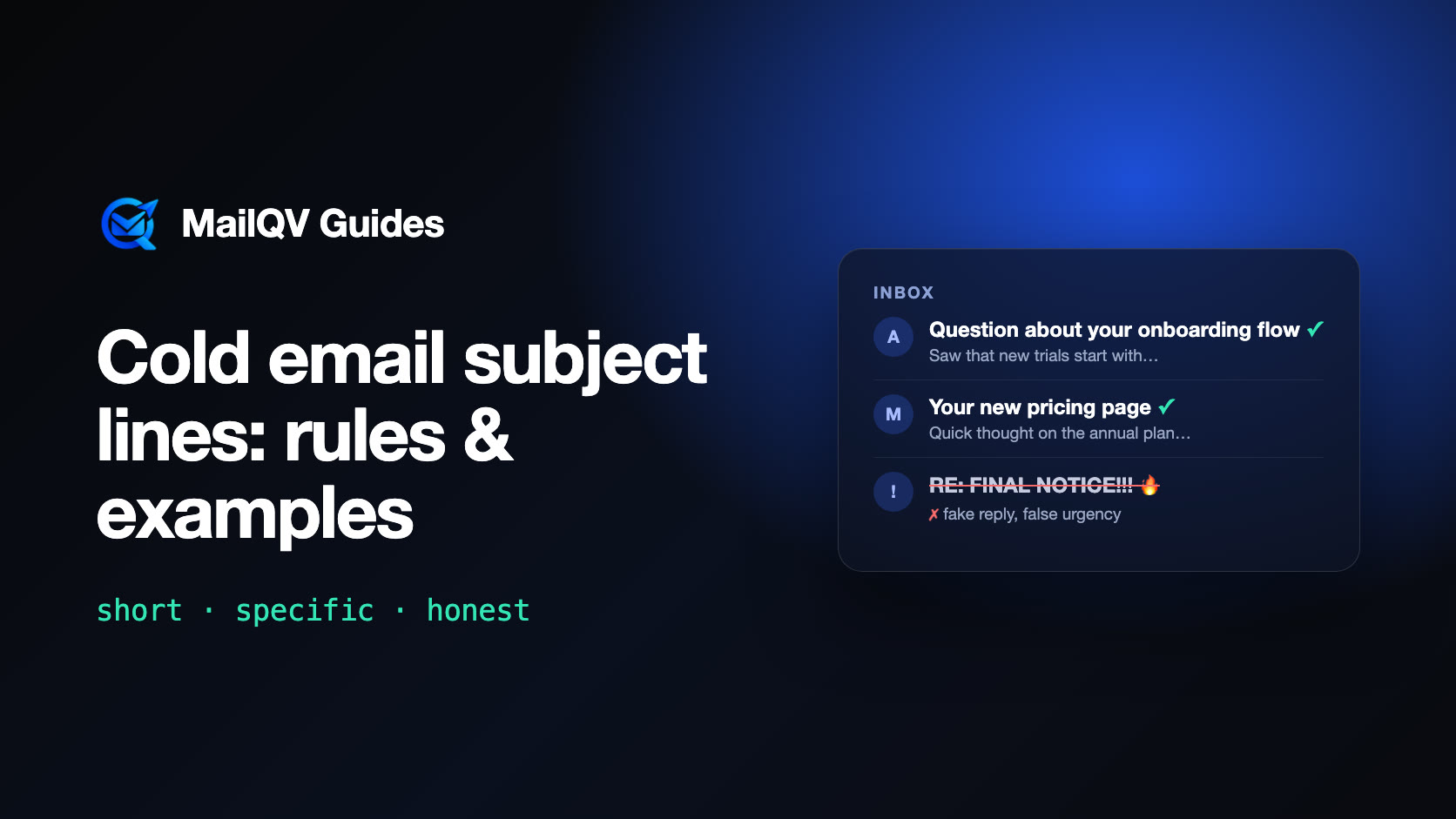
A good cold email subject line is short, specific to the recipient and honest about what the email contains. Aim for a few words that read like a note from a colleague—“Question about your onboarding flow”—rather than a headline. Avoid false urgency, fake “Re:” prefixes and capital letters, and judge subject lines by replies, not opens.
What a subject line has to do
In a crowded inbox, the subject line decides whether a message is opened now, later or never. In cold email it also sets expectations: a subject that promises something the body does not deliver turns an open into a complaint.
Rules that hold up
None of these is a trick; together they make the email look like it was written for one person.
- Keep it short: two to six words fit on a phone screen.
- Be specific: name a topic, team or problem, not a generic benefit.
- Use sentence case, not Title Case or capitals.
- Let the first line of the email continue the subject.
- Leave out your company name; the From line already shows it.
Example patterns by goal
Adapt these patterns to your offer; copying them word for word makes them generic again.
- Question: “Question about your outbound process”
- Observation: “Your new pricing page”
- Referral (only when true): “Sam suggested I reach out”
- Problem: “Trial-to-paid drop-off”
- Follow-up: keep the original subject so the conversation stays in one thread
What to avoid
Single words rarely decide spam filtering on their own, but deceptive subject lines generate complaints, and complaints do.
- Fake “Re:” or “Fwd:” prefixes on a first email.
- False urgency such as “Final notice” or “Action required”.
- All capitals, stacked exclamation marks or strings of emoji.
- Clickbait that the email does not deliver.
- Money, guarantee and “free” claims that read like an advert.
Test them properly
Open rates are a weak signal: privacy features load tracking pixels automatically, and a subject line can win opens while losing replies. Compare subject lines on reply rate across enough sends, change one thing at a time and keep the rest of the sequence identical.
Subject lines in MailQV
The free subject line tester checks length, mobile cut-off, capitals, punctuation and personalization before you send. Inside a campaign, the AI writer drafts the subject and body together from your offer and audience, and you can edit both before launch.
Frequently asked questions
How long should a cold email subject line be?
Short enough to show in full on a phone—roughly two to six words. Shorter is not automatically better; clarity matters more than length.
Should I personalize the subject line?
Only with data that is complete and accurate. An empty or wrong variable in the subject is more visible than one in the body.
Should follow-up emails use a new subject line?
Usually not. Replying in the same thread keeps the context together for the prospect. Use a new subject only when the follow-up starts a genuinely new topic.
Put it into practice
Run measured outreach with mailbox-level control.
MailQV connects sender rotation, sequences, contacts and campaign signals without claiming guaranteed inbox placement.