Deliverability
Hard Bounce vs Soft Bounce in Cold Email
Understand permanent and temporary email delivery failures and how each should affect future sending.
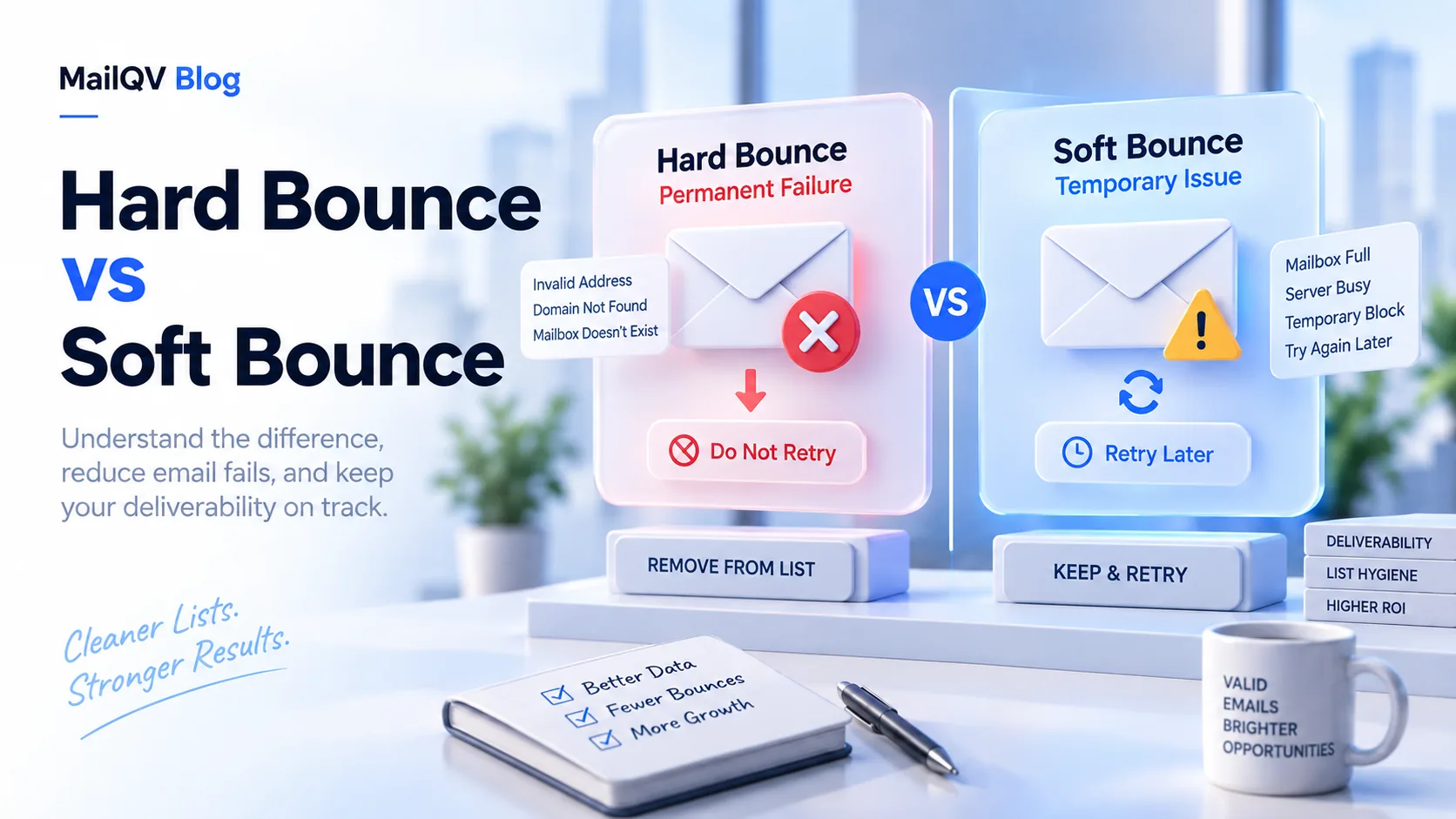
A hard bounce is a permanent delivery failure, such as a nonexistent address; suppress that recipient. A soft bounce is temporary, such as a full inbox or transient server problem; retry cautiously and suppress it if failures persist.
Read the server response
SMTP 5xx responses usually describe permanent failure, while 4xx responses usually describe temporary failure. Store the response code and reason because providers do not classify every edge case identically.
Example: “550 user unknown” generally means the address should not be tried again. “452 mailbox full” may succeed later, but repeated failures need a retry limit.
Create explicit handling rules
Continuing to send to permanent failures wastes capacity and can harm sender signals. Retrying every soft bounce forever is also unsafe.
- Suppress clear permanent recipient failures globally.
- Use limited, spaced retries for temporary failures.
- Review authentication or domain-wide failures separately.
- Do not treat a bounce as proof of inbox placement elsewhere.
Keep suppression centralized
A bounced address should not re-enter through a different campaign import. MailQV contact states help keep ineligible recipients out of future queues across the workspace.
Put it into practice
Run measured outreach with mailbox-level control.
MailQV connects sender rotation, sequences, contacts and campaign signals without claiming guaranteed inbox placement.