Email marketing
How to Build a Mailing List: A Practical Guide to Quality Contacts
Learn how to build a quality mailing list, organize contacts, segment audiences, validate data, and prepare a list for effective email campaigns.
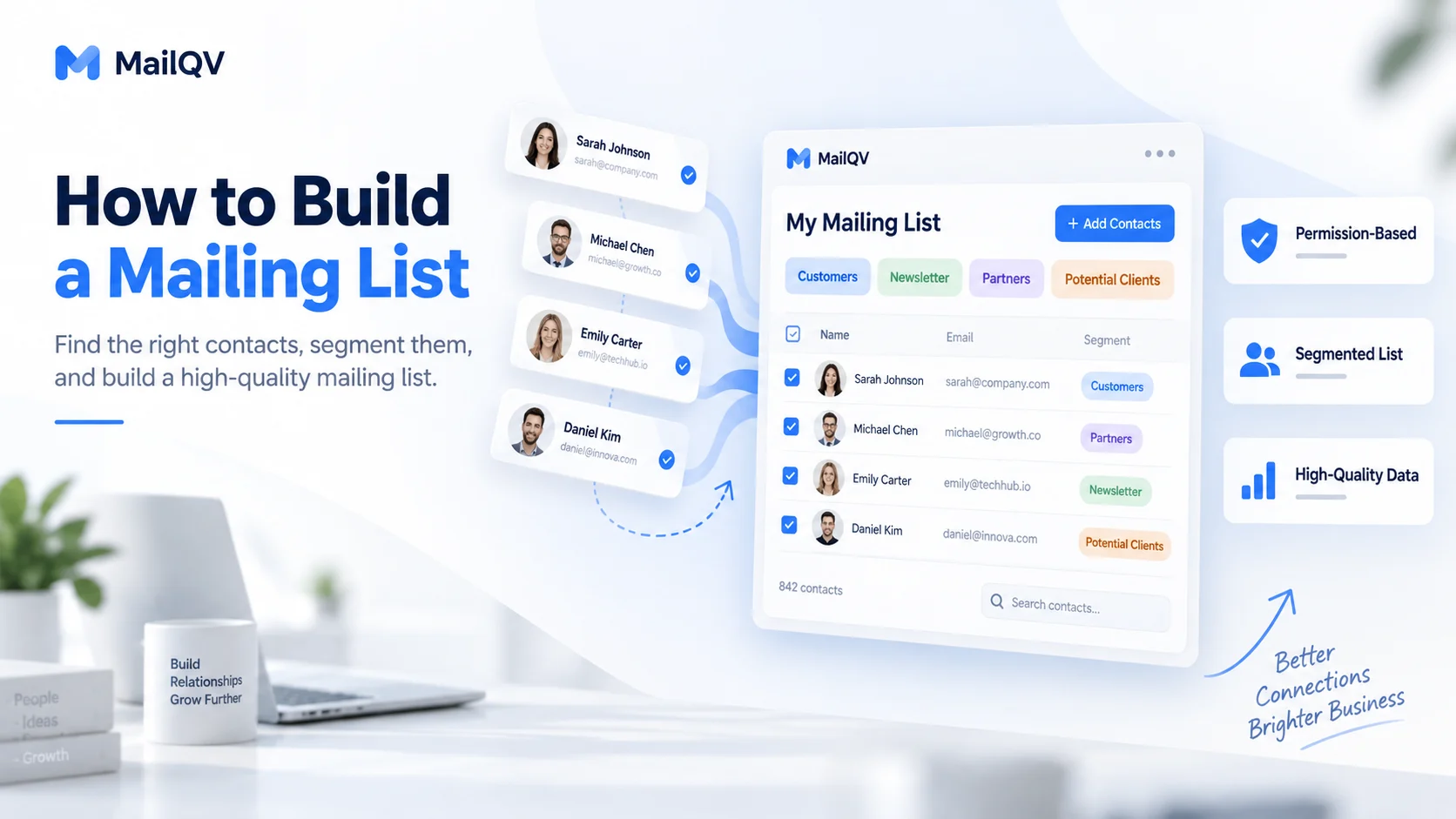
The mailing list is one of the strongest drivers of campaign performance. A beautifully written email sent to the wrong people will struggle; a simple message sent to a relevant audience can perform far better.
Overview
The goal of list building is not to collect as many addresses as possible. It is to organize people who have a meaningful connection to your message in a structured, usable dataset.
What is a mailing list?
A mailing list is a collection of contact records prepared for email campaigns. A basic list may contain only email addresses. A more useful structure can include name, company, role, country, source, segment, and custom fields.
Those fields make future segmentation and personalization easier.
How to build an opt-in mailing list
For newsletters and permission-based marketing, the strongest source is direct signup.
Common acquisition points include website forms, blog subscriptions, webinars, events, lead magnets, product communication preferences, customer account settings, and campaign landing pages.
Keep forms focused. Collect the information you actually need rather than adding fields “just in case.”
How to build a B2B prospect list
B2B sales list building follows a different workflow. The objective is to identify companies and decision-makers that plausibly match your product.
Start by defining the ideal customer profile:
Then research companies and contacts against those criteria. Make sure your data sourcing and use comply with the laws and platform terms that apply to your campaign.
- Industry
- Company size
- Geography
- Relevant roles
- Problem or need
- Trigger events
What fields should a mailing list include?
A practical baseline can include email, first name, last name, company, role, country, source, segment, and status.
For B2B outreach, website or domain, industry, company size, and a personalization note can also be useful.
Segment the list from the beginning
Segmentation should be part of list design, not an afterthought.
Examples include SaaS founders, sales leaders, agencies, ecommerce brands, current customers, trial users, and event attendees.
Use clear, maintainable segment names. Labels such as “List 1” or “New 2” become difficult to manage as your campaigns grow.
How to check list quality
Before sending, clean the list. Remove duplicate contacts, correct malformed addresses, suppress hard bounces, remove previous opt-outs, review missing personalization fields, and separate records with unclear sources.
Why purchased mailing lists are risky
Purchased lists often come with uncertainty around freshness, relevance, permission, and data quality. That can increase bounces, complaints, and low engagement.
Building your own list takes longer, but the relationship between audience and message is usually much stronger.
How often should a mailing list be updated?
A mailing list should not remain static. Every campaign produces new information: bounces, replies, opt-outs, conversions, and engagement signals.
Update records after campaigns and keep important suppression events, especially hard bounces and opt-outs, at a global level.
Importing a mailing list with CSV
Most mailing platforms support CSV import. A consistent column structure reduces mistakes.
Example:
email, first_name, last_name, company, role, country, segment, source
During import, confirm that each CSV column maps to the correct contact field.
List management in MailQV
MailQV can import contacts from CSV, map fields, organize contacts into categories or segments, and apply suppression rules before campaign sending. That structure becomes increasingly valuable as lists and campaign volume grow.
Conclusion
A good mailing list is not simply a large list. It is current, relevant, segmentable, and traceable to a known source. Better list quality usually creates more useful conversations with less wasted sending.
Put it into practice
Run measured outreach with mailbox-level control.
MailQV connects sender rotation, sequences, contacts and campaign signals without claiming guaranteed inbox placement.