Email marketing
What Is Bulk Mailing? A Guide to Controlled Bulk Email Sending
What is bulk mailing and how does bulk email work? Learn about audience lists, sending volume, segmentation, deliverability, and safe campaign operations.
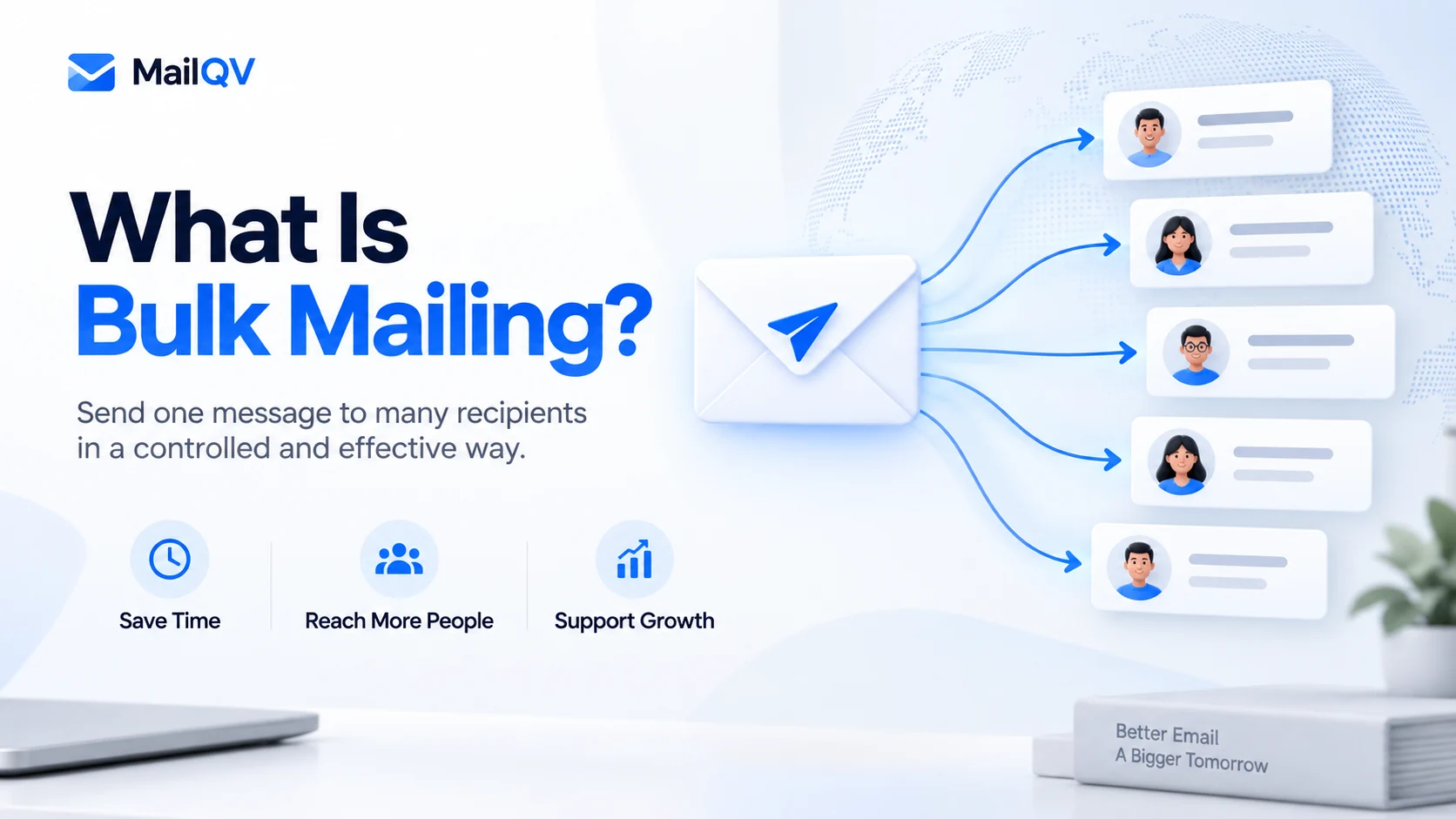
Bulk mailing is the process of sending an email message or campaign sequence to a defined group of recipients at scale. “Bulk” should not mean blasting thousands of messages at once without controls. Professional bulk mailing is segmented, paced, monitored, and measurable.
How does bulk mailing work?
The workflow has four basic stages: prepare the audience, create the message, schedule the sending operation, and measure the outcome.
A sending platform processes recipients according to campaign rules. It may apply daily limits, sending windows, mailbox selection, sequence timing, and suppression rules. Instead of sending the entire campaign at one moment, volume can be distributed over time.
Bulk mailing vs manual email
Manual sending requires someone to select recipients and send messages one at a time. Bulk mailing automates the same operational layer across hundreds or thousands of contacts.
The benefit is not only speed. The bigger advantage is process consistency: personalization fields, follow-up sequences, centralized reporting, and controlled sending.
Should everyone receive the same message?
Usually not. Even when you offer the same product, different recipients can care about different outcomes. A founder may focus on cost and speed, while a sales leader may care more about team productivity and pipeline.
Personalization therefore means more than adding a first-name field. The problem, angle, evidence, and CTA can also change by segment.
How many emails should a bulk mailing campaign send?
There is no universal safe number. Healthy volume depends on mailbox history, provider behavior, domain reputation, list quality, bounce rate, and the overall sending pattern.
For a new mailbox, controlled volume with gradual increases is easier to monitor. When multiple mailboxes are used, the workload can be distributed instead of concentrated on one account.
Why deliverability is critical
The first requirement of any campaign is reaching the inbox. Great copy cannot perform if messages fail before recipients see them.
Key deliverability factors include SPF, DKIM, DMARC, sender reputation, valid addresses, bounce and complaint rates, sending patterns, content quality, recipient engagement, and suppression management.
Mailing list hygiene
Old, purchased, unclear-source, or high-bounce lists can hurt both campaign performance and sender reputation.
A regular hygiene process should remove invalid addresses, suppress hard bounces, deduplicate contacts, honor opt-out requests, and separately evaluate segments that show no engagement over long periods.
Can bulk mailing still be personalized?
Yes. That is one of the strengths of modern email campaign systems. A campaign can use fields such as name, company, industry, or other custom attributes while still operating at scale. More advanced workflows can use different message variants for different segments.
Personalization only helps when the underlying data is accurate. Broken merge fields or incorrect company data can reduce trust immediately.
Follow-ups in bulk mailing
B2B campaigns often use a short sequence instead of a single message. Follow-ups should be concise, add context, and avoid repeating the first email word for word.
When a recipient replies, bounces, or opts out, the sequence should stop for that contact.
What to look for in a bulk mailing platform
Useful capabilities include mailbox connections, campaign sequences, sending windows, daily limits, mailbox rotation, contact segmentation, suppression, bounce handling, personalization, analytics, and CSV import with field mapping.
MailQV is designed as a mailbox-based mailing platform that brings these operations into one workspace.
Conclusion
Bulk mailing is not simply about sending a large number of emails. It is about delivering a relevant message to the right audience at controlled volume while maintaining the operational discipline needed to measure and improve results.
Put it into practice
Run measured outreach with mailbox-level control.
MailQV connects sender rotation, sequences, contacts and campaign signals without claiming guaranteed inbox placement.