Email marketing
What Is Mailing? A Practical Guide to Professional Email Campaigns
What is mailing, how does it work, and how is it different from email marketing? Learn the fundamentals, use cases, and best practices for professional mailing campaigns.
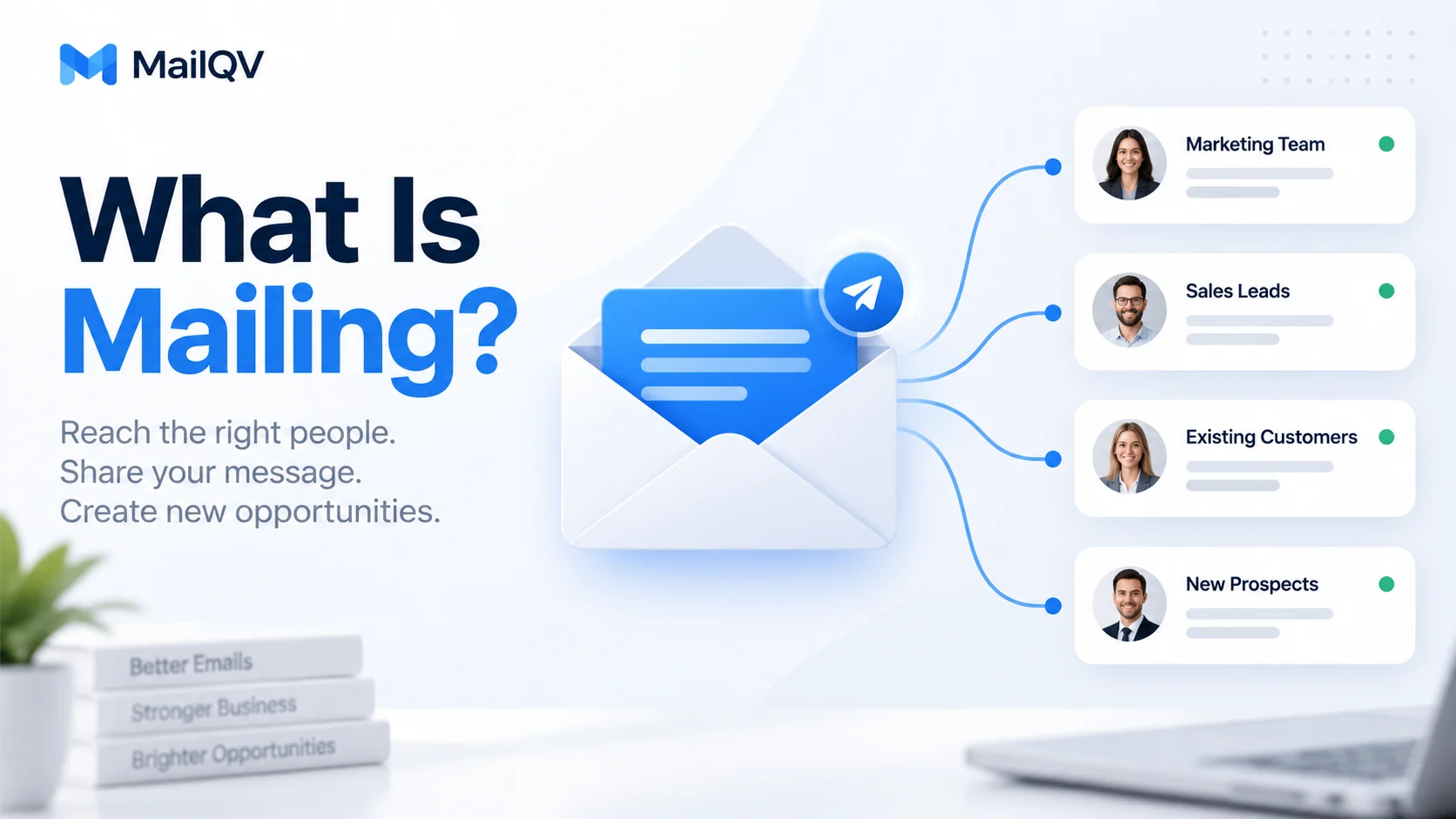
Mailing is the process of sending planned email messages to a defined audience. In professional use, it means much more than sending the same email to many addresses. Who receives the message, why it is sent, when it is delivered, and how the outcome is measured are all part of the campaign.
Overview
A product announcement, feature update, event invitation, sales message, customer acquisition campaign, or recurring newsletter can all be forms of mailing. Strong campaigns are built around a relevant audience, a clear message, controlled sending, and a measurable objective.
What does “mailing” mean in digital marketing?
In digital marketing, mailing describes organized communication with multiple recipients through email. The key word is organized. A campaign starts with a defined audience, uses a message written for a specific purpose, and is evaluated after delivery.
That is why professional mailing is different from indiscriminate bulk email. List quality, segmentation, sender reputation, timing, personalization, and performance analysis all matter.
What is mailing used for?
Mailing can support different goals depending on the business model. A SaaS company may announce a feature, an ecommerce brand may promote an offer, an agency may contact prospects, and an event business may send registration reminders.
Common use cases include:
The technology may be similar, but the message, sending frequency, and success metric should change with the use case.
- Product and feature announcements
- Promotional campaigns
- Newsletters and content distribution
- Sales and business development outreach
- Event invitations and reminders
- User activation and re-engagement
- Customer updates
Is mailing the same as email marketing?
Not exactly. Mailing usually refers to a specific send or campaign operation. Email marketing is the broader strategy that can include list growth, segmentation, automation, lifecycle communication, experimentation, reporting, and multiple campaign types.
In short, mailing is one execution layer inside a wider email marketing strategy.
What makes a good mailing campaign?
A professional mailing campaign has five core components.
1. A relevant audience: Send to people for whom the message has a genuine reason to matter.
2. A clear value proposition: Recipients scan emails quickly. The reason to keep reading should be obvious near the top.
3. A trustworthy sender: Sender identity, domain reputation, and technical authentication matter. SPF, DKIM, and DMARC are important building blocks for legitimate email delivery.
4. A clear action: The campaign should make the next step easy to understand, whether that is replying, booking a demo, starting a trial, purchasing, or reading more.
5. Measurement: Delivery, clicks, replies, conversions, bounces, and unsubscribes provide feedback for the next campaign.
Is mailing spam?
No. Mailing is a communication method; spam generally describes unwanted, irrelevant, or abusive messaging. The difference is not simply the number of emails sent. Audience relevance, list source, recipient expectations, sending behavior, and compliance with applicable rules all matter.
For marketing campaigns, permission and unsubscribe requirements should be handled according to the laws and platform rules that apply to your audience. For cold outreach, careful targeting, reasonable volume, relevance, and a clear way to opt out are especially important.
Common mailing mistakes
A frequent mistake is assuming that more volume automatically creates more results. If list quality is poor, sending more can simply increase bounces and complaints. Other common problems include jumping to high volume too quickly, sending one generic message to everyone, weak subject lines, poor mobile formatting, and failing to analyze the campaign after it runs.
What tools do you need for mailing?
Professional mailing usually requires a sending platform, contact and list management, a message editor, scheduling, suppression controls, and reporting. Teams using multiple mailboxes may also need mailbox rotation, daily limits, sending windows, and sequence management.
Mailbox-based platforms such as MailQV can help manage campaigns from connected inboxes while keeping contacts, sequence steps, sending limits, and performance data in one place.
Conclusion
Mailing is not simply “sending email to a lot of people.” It is a structured process of choosing the right audience, writing for a clear purpose, sending in a controlled way, and measuring what happens next. Done well, it becomes a direct and measurable channel for sales, marketing, customer communication, and content distribution.
The next step is execution. Continue with How to Do Mailing to build a campaign from the ground up.
Put it into practice
Run measured outreach with mailbox-level control.
MailQV connects sender rotation, sequences, contacts and campaign signals without claiming guaranteed inbox placement.